
Harford County Release Records
A release from the Harford County Detention Center means HCSO ended that person’s county-jail custody transaction. It does not always mean the person went home. A court may authorize release on recognizance or bond. A local sentence may end through time served, expiration, or applicable credits. HCSO may also transfer someone to the Maryland Department of Public Safety and Correctional Services, another county, a treatment placement, a hospital, or federal custody. Only the first group has left confinement for the community. A transfer records departure from HCDC while custody continues elsewhere.
The source of proof follows the movement. HCSO holds the booking and physical release record. The Maryland Judiciary docket explains the court order or sentence behind the change. VINELink may report a custody event sent by the participating agency. DPSCS controls later state-prison records, while BOP and ICE operate separate federal systems. The clearest finding names the event precisely: court-ordered release, HCSO-recorded exit, state transfer, federal transfer, or completed discharge.
- Release
- An end to one agency’s custody, which may be to the community or to another custodian.
- Discharge
- The end of the sentence or supervision status described by the responsible agency.
- Time served
- A court sentence satisfied by confinement credit already earned.
- Detainer
- A request that a jail keep custody briefly so another authority can assume it.
How Harford County Releases Occur
Harford County release records must be read by type, not just by date. The Inter-Agency Processing Center can book, photograph, check warrants, and take a person before a District Court commissioner in a short span. Some people leave after a recognizance or conditional-release decision. Others are committed to HCDC. A sentenced person may finish a local term or move to the Commissioner of Correction. Each event can look like an exit in one system while carrying a different legal result.
| Exit type | Meaning | Best next source |
|---|---|---|
| Recognizance or bond | Pretrial release under court terms | Harford court docket plus HCSO custody record |
| Time served or sentence end | Local confinement has ended | Sentence entry plus HCSO release transaction |
| Parole or mandatory release | Community custody may continue | MPC, DPP, VINELink, and agency release record |
| DPSCS transfer | County-jail custody ended, state custody continues | DPSCS Incarcerated Individual Locator |
| Federal or ICE transfer | HCDC exit without confirmed freedom | BOP, ICE, federal docket, or responsible district |
A dismissal or acquittal can remove the court basis for custody, yet HCSO still documents the actual departure. Likewise, a sentence entry supplies the legal starting point but is not a jail movement log. Matching the docket to the custody transaction avoids calling a transfer a release to the community.
Harford County Release Record Fields
HCSO does not promise that every field exists in one public report. A focused Maryland Public Information Act request can ask for the existing booking, custody-movement, and release transaction. The request should identify a person and booking period, then list the fields needed. This makes it easier for the custodian to locate an existing export or record and to separate any nonexempt material.
| Requested field | What it can establish |
|---|---|
| Booking number | Connects the release to the correct HCDC admission. |
| Admission date and time | Marks the start of the custody transaction. |
| Actual release date and time | Records when HCSO ended physical custody. |
| Release authority or type | May distinguish bond, court order, sentence end, or transfer. |
| Destination code | May identify a receiving agency when disclosable. |
| Charges tied to booking | Links the event to the relevant court cases. |
| Booking photograph | Associates the intake image with that booking, subject to review. |
Ask HCSO to identify the legal basis for any withheld field and to release all reasonably separable nonexempt parts. A field may be redacted, protected, or not retained in the form requested. The booking record also differs from the court file: HCSO documents custody, while the clerk maintains the judicial record.
Request Harford County Release Records
The HCSO public-information page now routes requests through its GovQuest portal. A narrow request is stronger than a broad question such as “was this person released?” It asks the agency for records that already exist and fixes the relevant date range.
- Identify the person by full name and, when lawfully known, date of birth or booking number.
- Give the approximate booking and release range. Request the existing booking, custody-movement, and release record.
- List the actual release time, release type or authority, destination if disclosable, charges, and booking photo as separate requested fields.
- Ask for electronic delivery and an itemized cost estimate before chargeable work begins.
- Keep the portal tracking receipt. If information is withheld, ask for the cited legal basis and all separable nonexempt material.
The older HCSO form identifies the PIA Liaison at P.O. Box 150, Bel Air, MD 21014-0150, phone 443-409-3403, and pia@harfordsheriff.org. Since the current agency page favors the GovQuest request portal, start there. Maryland law requires a prompt grant or denial no later than 30 days after receipt. When more than 10 working days are expected, the custodian must provide a status, expected timing, reasons, and estimated fees within that period.
The official HCSO request page shows how the agency routes and prices public-record requests.

The captured panel is a starting point for a request, not a promise that every release field or photograph will be disclosed.
Maryland Rules for Harford Records
Maryland’s Public Information Act, General Provisions Article Title 4, governs requests for existing executive-branch government records. It does not require HCSO to answer an open-ended inquiry, conduct research, or create a new release list. General Provisions §4-203 sets the response framework. Section 4-351 permits withholding of certain investigatory or correctional material when listed harms or privacy interests apply.
Juvenile, sealed, shielded, expunged, personal, and security-related material may also be limited. Court records follow Judiciary access rules and clerk procedures, not the HCSO request route. Federal records follow FOIA and agency rules. A precise request should accept lawful redactions while seeking the rest of the record.
Funds After Harford County Release
A Harford County audit supplies a concrete part of HCDC release logistics. The detention center returns the full inmate-account balance on release using a debit card. A balance under $5 may be returned as cash, and a check may also be used. This is evidence of a property and funds step at release. It does not identify a standard release hour, exit door, or pickup point.
Anyone planning to meet a released person should confirm timing directly with HCDC rather than infer it from a court order or account transaction. Harford Transit LINK offers county transportation routes and trip-planning tools, but the reviewed sources do not promise a stop at a release door. Check current service and the nearest stop before travel.
Note: The audit describes return of account funds, not a guaranteed form of payment in every individual case.
Harford IPC Release Decisions
HCDC houses the Inter-Agency Processing Center and Pre-Trial Services at the front of the custody process. A District Court commissioner may order release on recognizance, set conditions, or set bond. That judicial decision is not the same timestamp as physical release. HCSO must complete its processing and record the exit. The 2025 HCSO report lists 1,943 bail reviews, which shows why court and custody sources should be paired for same-day events.
The IPC may photograph and process a person who never spends a long period in a housing unit. Booking, court appearance, and release can all occur on the same date. Compare event times and case numbers before describing the length or outcome of the stay.
Harford Release Counts Need Context
Earlier HCSO reporting for 2020 counted 3,556 processed-in transactions and 2,997 released transactions. The 2021 reporting counted 3,404 processed in and 3,401 released. Both sets included returning weekenders. These numbers measure transactions, not distinct people, and they do not prove a final discharge for each entry.
Harford’s history of sentences served in nonconsecutive periods can create repeated entries and exits for the same person. A release count therefore cannot be converted into a list of unique Harford County released inmates. The custody record tied to the named booking remains the sound unit of proof.
Find Released Harford County Inmates
No single Harford system preserves every kind of release. HCSO has no verified public recent-release archive, and Maryland’s state locator removes people no longer in custody. The best search moves from identity and case context to the agency that controlled the last known custody.
- Search VINELink under Maryland and match the person, agency, and available identifiers. Record the exact status and query time.
- Search every plausible Harford District and Circuit Court case. Read commissioner, bond, disposition, sentence, credit, and later modification entries in order.
- Call HCDC at 410-638-3140 when current physical status matters. A court order can precede jail processing.
- For a transfer to state custody, use the DPSCS locator. A current match shows housing, while a miss does not prove release.
- For federal custody, use the BOP locator or ICE ODLS as appropriate. Treat an HCDC handoff as a transfer until later release is confirmed.
- Request the HCSO or DPSCS release transaction when an exact date, type, or destination is needed.
The Harford Jail Releases: 24 Hours page explains same-day verification when no public county feed exists. Use the full chain above for a named person.
Maryland Custody Search Limits
Maryland calls its tool the Incarcerated Individual Locator. It takes first and last name and reports housing for many people currently in specified DPSCS facilities. It is not a released-person history. DPSCS expressly says that people no longer in custody for any reason, including release or escape, are not listed.
| Field or result | Documented use | Limit |
|---|---|---|
| First name | Search input | Name variants may matter |
| Last name | Search input | A no-result is inconclusive |
| Housing location | Shows a listed person’s current placement | Not a release date or discharge history |
| Missing result | Signals that the tool did not return a current match | May reflect release, escape, coverage, timing, or spelling |
The official DPSCS locator page makes the released-person exclusion visible.
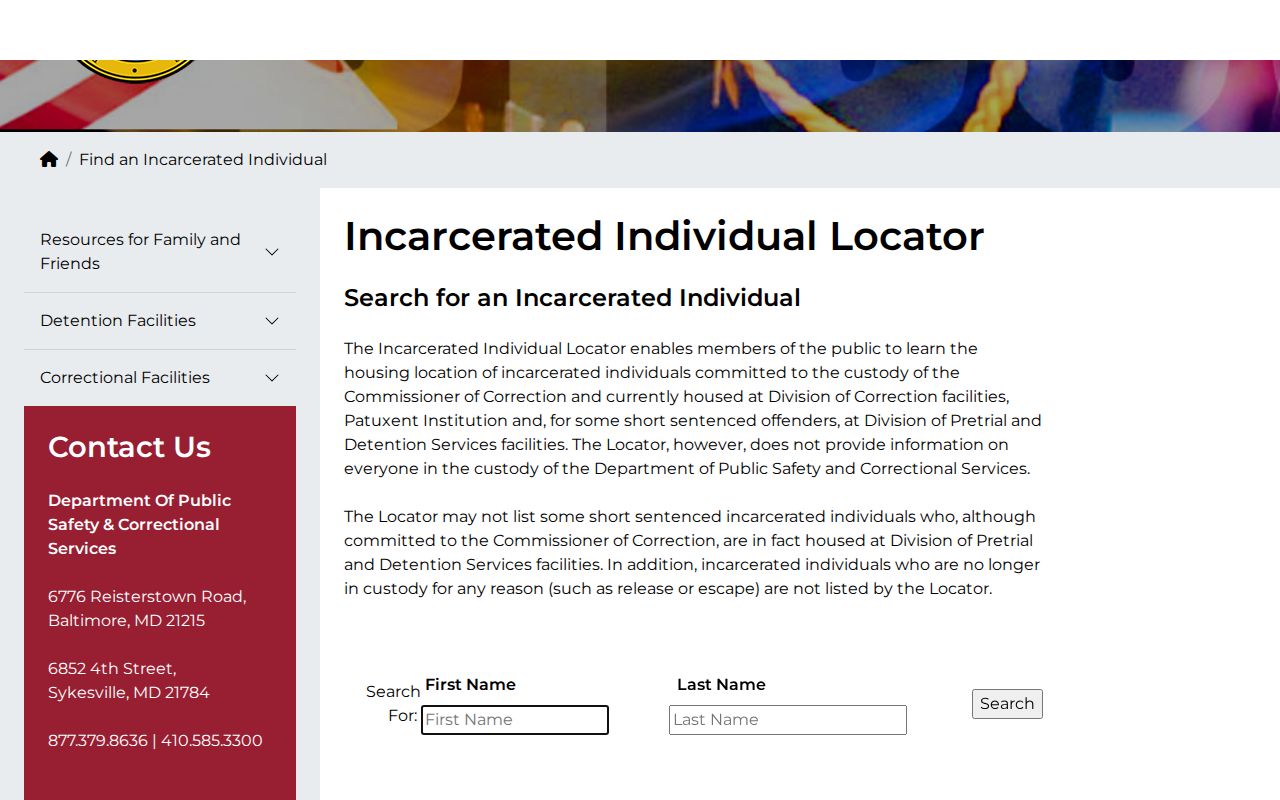
Because no projected or historical release field is published there, continue to VINE, court records, supervision sources, or a DPSCS public-information request.
Harford County Has No Release Feed
The official-site sweep found no HCSO web roster, 24-hour view, 72-hour view, released-person archive, or sheriff jail app with recent releases. That negative result must not be filled with scraped names or a current roster relabeled as releases. HCSO instead directs custody inquiries to VINE, while the county record portal supplies the durable request path.
For a defined date range, ask for an existing release log or export “if maintained” and state the start and end timestamps. If no such report exists, request the identified person’s custody transactions. Ask for fields and booking photos separately, accept lawful redactions, and do not require the agency to create a new report.
Harford Post-Release Supervision
The Maryland Parole Commission decides whether eligible people should receive parole. The Division of Parole and Probation supervises parole, probation, and mandatory-release cases in the community. These are separate roles. An MPC approval can still depend on a home plan or other terms, so approval is not proof of physical exit. A DPP office assignment concerns supervision after release, not present jail housing.
Maryland provides no general public name search for ordinary parole or probation status. Start with the sentencing docket, confirm the custody exit through VINE or the agency record, then contact DPP with identifying information. Harford has DPP field offices in Aberdeen and Bel Air. Disclosure limits may restrict what staff can confirm.
Harford Release Planning Services
HCDC documents a local layer of discharge planning before some Harford County releases. Its 2025 report records 454 discharge plans, 730 medication-assisted-treatment participants, and 582 peer-recovery sessions. County planning material also identifies mandated discharge policy ML04 and quarterly reentry stakeholder meetings. These figures show program activity, not an entitlement or promise of service for a named person.
Earlier HCSO material described help such as transit vouchers, treatment referrals, emergency-shelter referrals, medical-assistance applications, and links to problem-solving courts. Availability and eligibility can differ. Confirm an individual plan with the responsible HCDC or community provider rather than infer it from the annual totals.
Harford VINE and Federal Releases
VINELink is the custody search and notification route HCSO recommends. A matching record can show status, agency, location, and custody-event information supplied by the participating agency. Registration options can include phone, email, text, or app notices. Re-register after a move between courts, local detention, state prison, or supervision because one registration may not follow the person across systems. A missing VINE result is not proof of release.
The BOP Inmate Locator is different. It covers federal prisoners from 1982 onward and can display a release date and a released location or status. That result does not settle a Harford or Maryland case. ICE’s locator covers current detainees and some people released from ICE custody within the last 60 days. USMS has no general public person locator. Match the tool to the actual custodian.
Harford Release Search by Custodian
The same missing name means different things in different systems. Use the last known agency and the kind of case to choose the next check.
| System | Best evidence | What it cannot prove alone |
|---|---|---|
| HCSO and HCDC | County booking and actual release transaction | Later state or federal discharge |
| DPSCS locator | Current listed state housing | Historical release from state custody |
| Maryland Case Search | Court order, disposition, sentence, and case events | Exact physical exit time |
| VINELink | Agency-fed custody status or event | A complete permanent release archive |
| BOP locator | Federal release date and released status | Freedom from Maryland or ICE custody |
| ICE ODLS | Current ICE location and limited recent-release coverage | Older or unlisted immigration history |
Harford County Release Facilities
The Harford County Detention Center is the main county facility. Its Inter-Agency Processing Center handles booking and initial appearance. Maryland Division of Correction facilities take people committed to state custody, even though no state prison was identified inside Harford County. BOP institutions cover sentenced federal custody. ICE and USMS custody can follow a federal detainer or court process. Each facility page follows the source that owns the later release record.
Harford Court Release Trail
Harford criminal cases can be split between District and Circuit Court. District Court handles misdemeanors, certain felonies, traffic matters, and commissioner proceedings without jury trials. Circuit Court handles other felony and jury matters. Search both. Harford criminal coverage in Maryland Case Search begins June 21, 1999, and public entries may remain indefinitely unless a court-ordered process removes them.
Read each plausible docket in time order. Bond, commitment, disposition, sentence, credit for time served, probation, violation, and modification entries can explain why custody changed. Yet “closed” or “disposed” does not record the minute HCDC opened the door. The custody agency remains the source for that event.
Harford Release to ICE
“Released to ICE” describes a handoff, not a return to the community. ICE explains that a detainer can ask a jail to maintain custody for up to 48 hours beyond the point when ordinary release would occur so DHS can assume custody. Harford’s historical immigration arrangement changed in 2026, so current local policy must be rechecked before describing any agreement as active.
For an individual event, confirm HCSO’s destination field if disclosable, then search ICE ODLS or contact the appropriate federal channel. Do not infer community release from disappearance at HCDC. A transfer ends county custody while federal custody begins.
Expunged Harford Release Records
Expungement can explain why a later public search no longer shows a case. Maryland says qualifying cases with all favorable outcomes entered on or after October 1, 2021 generally receive automatic expungement after three years. Expungement removes covered information from court and law-enforcement records. Shielding instead removes qualifying information from public view while preserving authorized access. Neither process means the historical custody event never happened.
The Harford Circuit Court expungement page and Maryland legal-help materials explain forms and eligibility paths. The Harford County Bar Foundation lists rotating brief-advice clinics. Eligibility depends on the case, so do not assume a missing result proves expungement or promise that a record can be removed.
Note: Keep personal copies of court orders because later public copies may no longer be available after record treatment.