
Harford Projected and Actual Release
A projected release date is an agency's current calculation based on a sentence, credited time, applicable diminution credits, and known legal limits. Diminution credits are deductions that may reduce time spent in confinement. An actual release date is the custody transaction recorded after the person exits that agency's control or is transferred. The dates may match, but the projected date can move before the exit occurs.
A pretrial HCDC detainee usually does not have a sentence-based projected date. A commissioner or judge may authorize release on recognizance, set bond, change conditions, or keep the person committed. Even after a court order, HCSO must finish physical processing and check other cases, warrants, or detainers. The official HCDC page is the local custody contact point. A sentenced HCDC person has a local calculation. A person committed to the Commissioner of Correction has a separate DPSCS calculation.
Scheduled vs. actual: Treat the calculated date as tentative until HCSO or DPSCS records the custody exit. A court entry can explain authority without proving the exact time the person left.
A transfer also changes the question. Leaving HCDC for a Maryland prison, another jail, ICE, or federal custody is not release to the community. The receiving agency then controls its own projected and actual dates. The Harford County release-record search explains how to trace that custody path when the destination is unclear.
Find a Harford Projected Release
Maryland does not publish one online field that answers every Harford County release-date question. The DPSCS Incarcerated Individual Locator shows current state placement for many people, but its official description lists no projected, tentative, maximum, or mandatory release field. It also removes people no longer in custody. A no-result cannot be turned into a release date.
- Identify the current custodian. Call HCDC or use current custody sources for a county case; use DPSCS for a state commitment. Do not assume that a transfer out of Harford custody is community release.
- Open every plausible Harford case in Maryland Judiciary Case Search. Transcribe the full sentence, credit for time served, suspended portion, and whether terms are concurrent or consecutive.
- For an HCDC sentence, use the HCSO public-record instructions to seek the existing custody calculation or release transaction. Local credits follow Maryland Correctional Services Title 11.
- For a state sentence, request the current calculation and commitment/release record from the DPSCS Public Information Act office. Include the SID or DOC number, institution, sentence, and date range when known.
- Check for parole action, mandatory supervision, another court order, or a hold. Label the agency's current date as projected until a later record confirms the actual exit.
The official DPSCS locator page below shows the search fields and its current-custody limit.
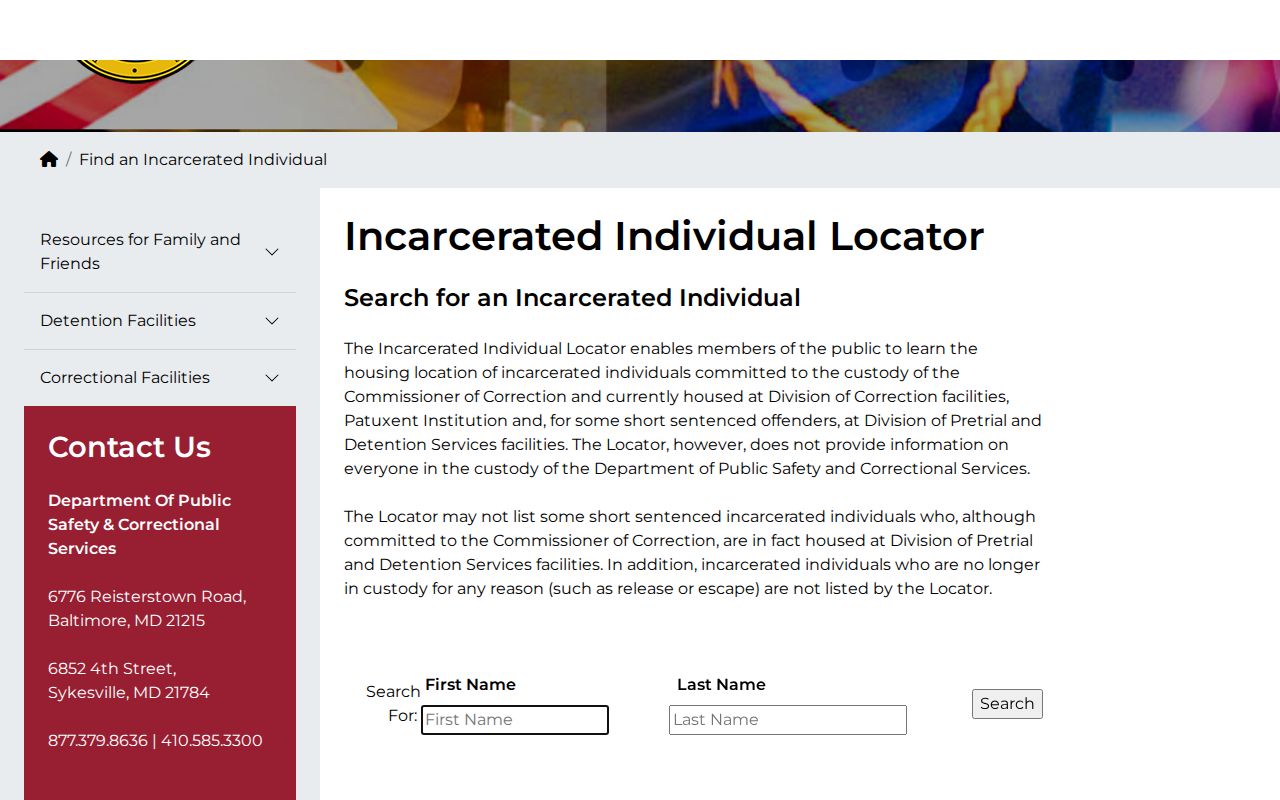
The warning is central to a Harford County projected release search. If a former state prisoner disappears from this locator, continue with VINE, the sentencing docket, supervision records when applicable, and a DPSCS record request.
Note: Preserve the query date and the exact label shown because a live custody locator is not a durable historical release record.
What Changes Harford Release Dates
A sentence is the base, not the full calculation. Several official events may change the date before release. Some add or remove credited time. Others create a separate custody basis even after the original term appears complete. Only the jail or DPSCS calculation can reconcile all of them for a named person.
| Factor | Possible effect | Record to check |
|---|---|---|
| Presentence credit | Counts qualifying time already served toward the sentence | Sentencing order and agency calculation |
| Concurrent or consecutive terms | Changes whether terms overlap or run one after another | Complete sentence in every case |
| Diminution credits | May reduce confinement under the state or local framework | HCDC or DPSCS calculation ledger |
| Discipline or noncustody time | May revoke credits or exclude time from earning | Correctional calculation and decision record |
| Court modification | May change the controlling term or credit | Later docket order |
| Parole or administrative release | May permit conditional community release before sentence expiration | MPC action plus actual custody event |
| Warrant or detainer | May cause continued custody or transfer to another authority | Holding and receiving agency records |
Parole eligibility is only permission to be considered. It is not the day a person leaves. Likewise, mandatory supervision is a conditional release after the term less applicable credits has been served, not an unconditional sentence discharge. A later violation or revocation can change custody again.
Another agency's detainer can turn an expected community exit into a transfer. If HCSO records that the person left for DPSCS, ICE, USMS, or another county, follow that recipient's system. Calling every departure “released” erases the difference between physical movement and freedom from custody.
Maryland State Release Credits
State sentences use Correctional Services Title 3. Section 3-702 establishes the credit entitlement and exclusions. For an eligible state term, Section 3-704 generally awards ten good-conduct days per calendar month. It generally uses five days when the term includes a crime of violence or specified controlled-substance crimes. The statute also excludes specified stayed, escape, noncustody, and uncredited post-revocation time.
Work credit under Section 3-705 is five days per month for satisfactory assigned work. Education or program credit under Section 3-706 is also five days per month for qualifying progress or completion. Special-project credit under Section 3-707 can be up to twenty days per month generally, with a lower limit for specified sentences. Section 3-708 applies combined caps, generally twenty days for its restricted group and thirty days for others, subject to the statute's exceptions.
These figures cannot be added mechanically without the person's ledger. Eligibility, proration, overlapping credit periods, restricted offenses, and forfeiture all matter. Under Section 7-501, qualifying people serving more than eighteen months receive conditional mandatory release after serving the term less applicable credits. For a violent crime committed on or after October 1, 2009, that conditional release cannot precede the parole eligibility set by Section 7-301(c) or (d).
Maryland does not have one universal rule that every person must serve 85 percent. Offense type, sentence date, mandatory portions, parole rules, and credit rules differ. A blanket percentage can produce a false Harford County projected release date.
Harford Local Release Credits
HCDC local sentences follow a separate Title 11 framework. Section 11-503 provides five days per month of prorated presentence good-conduct credit from arrival until local sentence, DOC commitment, or release. Section 11-504 provides an initial postsentence deduction of five days per month when the term includes a violent or specified drug crime and ten days otherwise, also prorated.
Section 11-505 permits five days per month for exceptional assigned tasks or satisfactory vocational or educational progress. Section 11-506 permits up to five days per month for designated projects or programs. Section 11-507 allows revocation of specified good-conduct credits through due process and treats task or project credits separately.
This local system applies to the HCDC calculation, not to a person already committed to Maryland Division of Correction custody. The court sentence may not display the live credit total. Ask HCSO for the existing calculation, and include all case numbers so consecutive or overlapping terms are not lost.
Note: Local HCDC credit rules cannot be substituted for the state DOC framework merely because the underlying criminal case began in Harford County.
Harford Release Search Gaps
Harford County has no verified public recent-release feed, while Maryland's state locator removes people who are no longer in custody. The locator even names release and escape as different reasons a person may be absent. That combination makes a missing search result weak evidence. It cannot establish a completed release or supply a projected date.
Use several propositions, each tied to its own source. The court sentenced the person. HCSO or DPSCS calculated a date. A court or parole authority changed the legal basis. VINE displayed a custody event. The jail or corrections agency recorded the actual exit. Keeping those facts separate prevents a projected release from being mistaken for a completed one.
When the online trail stops, make a narrow public-record request. Ask for an existing commitment, sentence-calculation, credit, release, or discharge record. Specify name, date of birth, SID or DOC number if known, institution, sentence, and range. A Harford District Court source can help route a local sentence-record question. Maryland General Provisions §4-203 requires a prompt response no later than thirty days and an interim notice within ten working days when more time is expected, but exemptions and redactions may limit production.
Two Harford Release Calculations
Maryland's separate local and state diminution systems are the key Harford County release-date quirk. Title 11 controls many local HCDC calculations. Title 3 controls eligible state terms. Discipline can change credits in either system, but the governing sections and monthly amounts are not identical. A sentence-only calculator cannot determine which ledger entries the agency has awarded, prorated, excluded, or revoked.
The state also uses a “tentative administrative release eligibility date” in Correctional Services §7-301.1 for a limited program. That statutory phrase does not mean the DPSCS locator publishes a general projected date for every incarcerated person. It also is not the same as maximum sentence expiration or an actual release.
The official §7-301.1 text shown below is the source for that limited term.
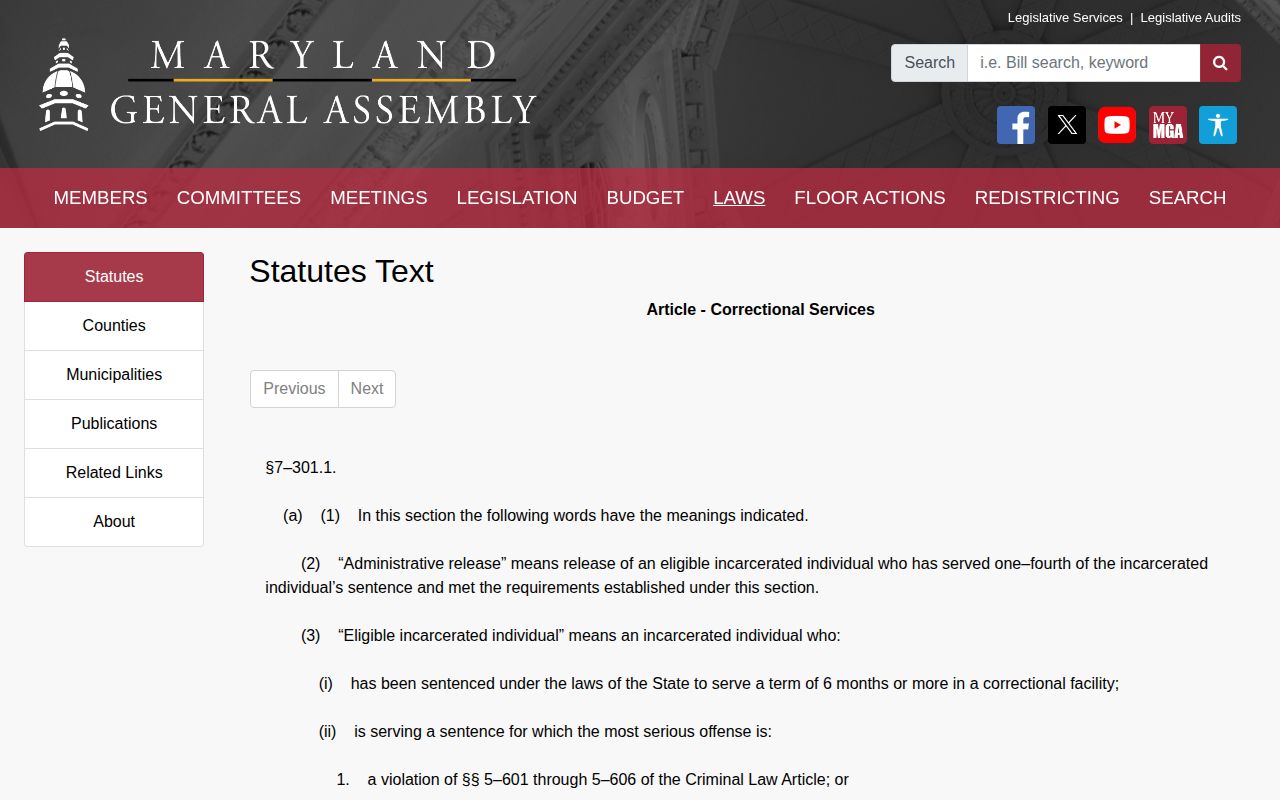
The statute helps define one legal calculation. It does not create a universal public date field. For an upcoming custody change, a VINELink inmate search and notification can supplement the agency calculation, but urgent confirmation still goes to HCDC or DPSCS.
Confirm a Harford Actual Release
Read every Harford sentence before estimating. District Court and Circuit Court may each hold a case for the same person, and a later violation or modification can control the result. The docket may show a term, suspended portion, credit for time served, probation, and whether one term runs with or after another. Copy the wording instead of reducing it to a single number. Then ask the custodian which orders and credits appear in its live calculation. A clerk's entry explains the judicial action, while HCSO or DPSCS remains responsible for its own custody ledger.
When the projected day arrives, check for a new court order, warrant, detainer, transfer, or agency update before arranging around the date. VINE may provide a useful event notice, but its timing depends on the participating agency's data. An HCDC telephone confirmation can address an urgent local question. A written HCSO or DPSCS release transaction is stronger for the lasting record because it can state the actual date, release authority, and destination where those fields exist and are disclosable.
The safe method is simple: copy the complete sentence, identify the custodian and credit regime, note all other holds and terms, then request the current calculation. Label any hand calculation as an estimate. Afterward, use the originating custody transaction to confirm the real Harford County release date.