
Harford State Prison Transfers
No Maryland Division of Correction institution was identified inside Harford County in the official facility materials reviewed. That does not mean a Harford sentence stays local. A court can commit a person to the Commissioner of Correction, and HCDC can transfer that person to a state institution elsewhere in Maryland. HCSO records the departure and receiving agency. DPSCS becomes responsible for later placement, state confinement, and release.
That division of authority is crucial. “Transferred from HCDC” establishes the end of county-jail custody, not the end of confinement. State institutions may be in the Baltimore, Sykesville, Jessup, Westover, Hagerstown, or Cumberland areas. Placement can also change during a sentence. The statewide agency, rather than a Harford jail page, is the correct source after state intake.
| Event | Responsible source | Meaning |
|---|---|---|
| HCDC transfer | HCSO release or movement record | County custody ended |
| Current state placement | DPSCS locator | Person appears in covered state custody |
| State release | DPSCS release record and VINE | Physical state confinement ended |
| Parole or mandatory supervision | MPC, DPP, and DPSCS record | Conditional community supervision may continue |
| Sentence discharge | DPSCS and supervision record | Sentence or supervision status reached its recorded end |
DPSCS Current Custody Locator
Maryland calls the public tool the Incarcerated Individual Locator. It accepts first and last name and reports placement for many people currently committed to the Commissioner of Correction. DPSCS describes coverage that includes Division of Correction facilities, Patuxent Institution, and some short-sentenced people in pretrial and detention facilities. It does not claim to cover every person held by DPSCS.
The key warning is explicit. People no longer in custody for any reason, including release or escape, are not listed. The tool therefore does not maintain a public released or discharged profile. Its documented result is a current facility location. It does not promise a public release date, parole date, supervision office, photograph, or discharge reason.
The official locator screenshot below comes from the DPSCS search page.
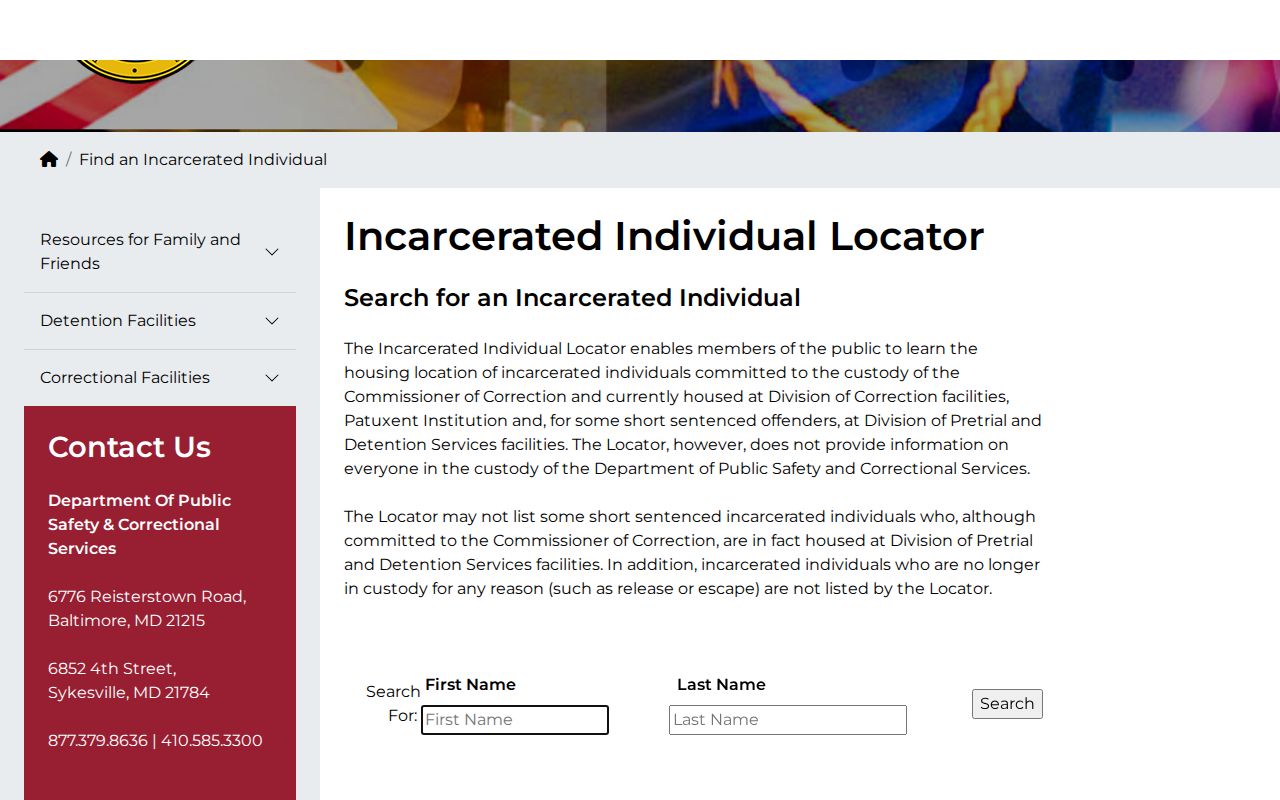
The view illustrates why a no-result cannot be converted into a release claim. It may reflect release, escape, an uncovered custody type, a name mismatch, or data timing.
Confirm a Maryland Prison Release
A released-first procedure preserves what each source can prove. Begin with the state locator to check whether the person still appears in covered custody. Use documented name variants and compare a result against date of birth, SID or DOC number, and the Harford case when those identifiers are lawfully available. Save the query date because the result is current, not historical.
- Search the DPSCS locator by first and last name. Treat a current match as placement evidence, not as a projected-release report.
- If the person is absent, search Maryland on VINELink for custody-event information supplied by participating agencies.
- Read the Harford sentencing docket in Maryland Judiciary Case Search for commitment, sentence, and later court action.
- If parole, mandatory supervision, or probation is expected, route verification through the Division of Parole and Probation.
- Request the existing DPSCS commitment, release, discharge, and calculation records for an authoritative state transaction.
A sentence entry is not a prison movement log. VINE depends on the participating agency feed. The state locator is only a present-placement tool. The DPSCS record is the strongest source for the agency’s actual release, while the court record remains authoritative for the sentence and judicial changes.
Request DPSCS Discharge Records
DPSCS provides a Public Information Act request page and an agency form. Identify the person by full name, date of birth, SID or DOC number if known, institution, and a focused date range. Ask for existing commitment, release, discharge, and sentence-calculation records. Useful fields include actual release date, release type, sentence or discharge status, destination, and supervising unit where disclosable.
The request should not ask DPSCS to write a narrative or compute an answer that is not stored in a record. It can also seek a DOC identification photograph in its existing form if needed and disclosable. DPSCS does not own the HCDC booking record or the court docket. Those go to HCSO and the relevant clerk.
DPSCS Office of Constituent ServicesPIA Coordinator
6776 Reisterstown Road, Suite 212
Baltimore, MD 21215
dpscs.pia@maryland.gov
DPSCS publishes the first two hours of search and preparation as free. Its listed copying charge is 50 cents per page, with another 50 cents per page for certified true copies, plus postage. A total cost of $1 or less is not charged. The agency may issue an estimate and require advance payment. A public-interest fee waiver is discretionary.
Maryland General Provisions §4-203 requires a prompt grant or denial no later than 30 days after receipt. If more than 10 working days are expected, the custodian must provide the statutory interim notice about status, reason, anticipated timing, and estimated fees. Exemptions and redactions may apply. Ask for all reasonably separable nonexempt parts.
Maryland Release Date Limits
The public locator documents no projected, tentative, or maximum release-date field. Maryland law does use “tentative administrative release eligibility date” for a limited statutory program, but that term does not mean the locator publishes a date for every prisoner. Future eligibility also is not the same as actual physical release or final sentence discharge.
A state sentence is affected by the court’s full order, presentence credit, concurrent or consecutive terms, mandatory portions, diminution credits, revocation, escape or other noncustody time, parole, administrative release, and later court action. Maryland should not be summarized as having one universal 85-percent rule. Its credit and eligibility laws vary by offense, sentence, and date.
Maryland’s state-sentence credit framework includes good-conduct, work, education or program, and special-project credits, with statutory exclusions and combined limits. Discipline can also affect earned credit. Conditional release under mandatory supervision can occur when an eligible term less applicable credits has been served, but it remains conditional and is not the same as final sentence expiration. The agency calculation, not a simple public date calculator, controls the working release date.
- Projected date
- An agency calculation that can change before actual release.
- Parole
- Conditional release authorized through the parole process before sentence expiration.
- Mandatory supervision
- A conditional release tied to the sentence less qualifying credits, not an unconditional sentence end.
- Discharge
- The recorded end of a sentence or supervision status.
The calculated DPSCS record is the sound source. Court-based arithmetic should be labeled only as an estimate. The state custody transaction later confirms the actual exit.
After Maryland Prison Release
Physical release from a Maryland prison may begin parole or mandatory supervision. The Maryland Parole Commission makes parole decisions. The DPSCS Division of Parole and Probation supervises people in the community. These agencies perform different functions, and neither role should be inferred from a missing locator result.
For a Harford connection, DPP has field offices in Aberdeen and Bel Air. Maryland does not publish the office directory as a general name-based supervision lookup. The office can serve as a verification and routing channel subject to disclosure limits. The sentencing docket may also identify parole, probation, or mandatory supervision language.
The Maryland Parole Commission and DPP should not be merged. The Commission addresses parole decisions and publishes hearing and public-session material. DPP handles field supervision after release. An approval decision also may precede physical release because final processing, another warrant, or a detainer can still affect the exit. Confirm the actual prison transaction separately from the decision date.
A person can therefore be released from prison while the sentence continues under conditions. Later discharge from supervision is another event. The Harford County probation and parole page explains the local office route and the difference between release decision and field supervision.
Note: Preserve the agency’s exact label because prison release, mandatory supervision, parole, probation, and final discharge are not interchangeable.
Maryland Correctional Facility Scope
Maryland Division of Correction facilities serve state sentences connected to Harford County. No single prison is identified inside Harford. The official state directory places institutions across several Maryland regions, and DPSCS may assign or move a sentenced person within that network.
Contact and records routing should follow the person’s actual institution when known. A former DPSCS prisoner seeking a personal base or medical file has a separate self or authorized-representative route through the release institution or the Case Management Office for Operations at 410-585-3300. Public-record requests for a state release go to DPSCS. Local booking and release requests remain with HCSO.
Identity matching remains essential across all channels. Use full legal name, variants, date of birth, state identification number, DOC number, and case number when lawfully available. A common-name result or a simple absence does not meet the standard for a completed Maryland prison release.