
Harford Probation and Parole Compared
A person on parole has left confinement before the full sentence expires and remains subject to conditions during the rest of that sentence. The Maryland Parole Commission makes parole decisions for eligible Maryland sentences. The DPSCS Division of Parole and Probation, called DPP, supervises the person in the community. Approval by the Commission is not the same as release. A home plan or other prerequisite may still be pending, and the later custody event establishes whether the person actually left.
Probation comes from a court order. A judge may suspend part of a sentence and direct that the person follow conditions in the community. Probation can begin after a local jail term, after time served, or without a term of confinement. Mandatory supervision is a third path. It is a conditional release based on the sentence less eligible diminution credits, which are credits that may reduce time in confinement. DPP also supervises that status.
| Supervision | Who authorizes it | Best first record | Who supervises |
|---|---|---|---|
| Parole | Maryland Parole Commission | Commission decision and later custody event | DPP field office |
| Probation | District or Circuit Court judge | Sentence and probation order | DPP field office |
| Mandatory supervision | Maryland law and the sentence calculation | DPSCS release and calculation record | DPP field office |
| Discharge | Controlling court or corrections authority | Closing order or official supervision record | No active supervision after completion |
The distinction matters because a jail roster answers only a custody question. It is not a public list of people on ordinary Harford County parole or probation. A released person may disappear from the HCDC roster yet remain under DPP supervision for months or years. The court and supervision records carry that later phase.
Verify Harford Post-Release Supervision
No official Maryland directory provides a general name-based search for ordinary probation or parole assignments. Verification therefore requires a short chain of records. Start with identity, not a status guess. Full legal name, date of birth, court case number, and a SID or DOC number can prevent a same-name error. Then separate the sentence, the physical release, and the supervision assignment.
- Search the Maryland Judiciary Case Search for every plausible Harford criminal case. Read the sentence, suspended term, probation, violation, and later modification entries in date order.
- For parole, review the Maryland Parole Commission source. Treat an approval as a decision, not proof of an immediate exit from custody.
- Confirm the custody change through HCDC, VINE, or the originating correctional agency. Maryland's current-custody locator removes people no longer held, so a missing name cannot prove release or supervision.
- Contact the Harford DPP field office that may hold the assignment. Give identifiers and ask whether staff can confirm the office or route the inquiry, understanding that disclosure limits may apply.
- For a durable answer, request the existing supervision, release, or discharge record from the agency that created it. Ask for the record, not a new explanation.
The Harford County released-inmate search and records path supplies more detail when the unresolved issue is the physical exit rather than supervision. A DPP confirmation supports active community supervision. It does not by itself supply the HCDC release time, release type, or transfer destination.
Important: A DPSCS locator miss does not prove parole, probation, discharge, or freedom from custody. The locator is built to show current state placement, not historical supervision.
Note: Record the office, date, identifiers used, and exact status wording so later checks can distinguish an update from a different result.
Harford Parole and Probation Offices
Harford County has two DPP field offices. The official DPSCS field-office directory lists Aberdeen and Bel Air. The directory routes people to an office, but it is not a searchable roll of supervised people. Staff may need a full name and an identifying number before deciding whether they can confirm an assignment or direct the inquiry.
Aberdeen Field Office
31 West Bel Air Avenue
Aberdeen, MD 21001
410-297-2200
Fax: 410-273-9532
Bel Air Field Office
State Multi-Purpose Center
2 South Bond Street, Suite 302
Bel Air, MD 21014
410-836-4650
Fax: 410-838-1470
The Commission and DPP serve different roles. The Commission is at 6776 Reisterstown Road, Suite 302, Baltimore, Maryland 21215, and its published numbers are 410-585-3200 and 877-241-5428. DPP headquarters is in Suite 212 at the same street address, with 410-585-3500 and 877-227-8031. The local offices remain the more direct routing points for a Harford supervision question.
The official Commission page also publishes hearing and public-session material. A public agency-meeting agenda is not a full calendar of named prisoners, however, and meeting minutes cannot prove an individual release. MPC's published outcomes include refusal, rehearing at a later time, or approval. Even approval may be followed by plan review and conditions before release occurs.
Harford Parole Decision Records
The Commission record can answer whether Maryland approved parole consideration, while the custody record answers whether and when the person left. That separation keeps a projected event from being reported as a completed release. A later DPP record can then show whether supervision began and which office received the case. The Maryland Parole Commission page shown below provides the official agency description and current public-session route.
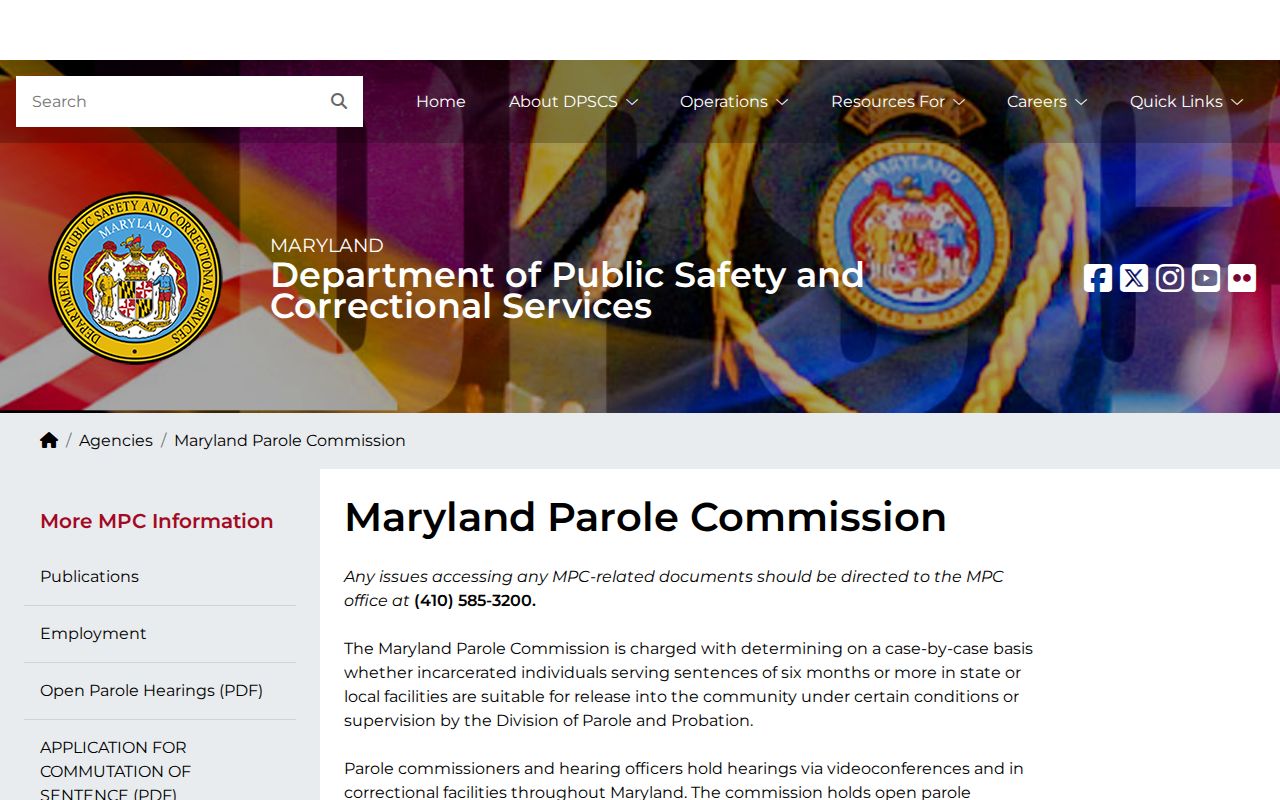
This source helps identify the decision-maker, but a named Harford County person's result still requires identifiers, the individual record, and a later release check. Public meeting material should never be stretched into a person-level release claim.
VINE may provide custody and supervision-related events supplied by participating Maryland agencies. Registration can be useful when a case moves from court to HCDC, state custody, and then supervision. Maryland materials advise searching again and re-registering after a known move because one registration should not be assumed to follow every agency transition.
Note: An MPC eligibility date permits consideration; it is not a promised parole date, an order to open a jail door, or a discharge date.
Harford Supervision Violations and Warrants
Conditions vary with the court order, Commission action, and supervision plan. At a high level, they may require reporting, compliance with treatment or other lawful directives, and avoiding new violations. The exact signed order controls. A breach may lead to a violation filing, a warrant, a hearing, changed conditions, or revocation. Revocation means the authority can withdraw the conditional community status and return the person to custody as the law and order allow.
An absconder is a supervised person alleged to have stopped reporting or otherwise avoided supervision. That term should come from the responsible agency, not from a missed appointment or a rumor. Research found no comprehensive official public Harford County parole-absconder list. The HCSO contact directory gives 410-836-5457 for the Apprehension/Warrants Unit, while DPP describes its warrant-apprehension role. The issuing court or agency is the right source for a named warrant.
- Parole
- Conditional release from confinement while the sentence continues.
- Probation
- Court-ordered community supervision, often tied to a suspended part of a sentence.
- Mandatory supervision
- Conditional release after the term is reduced by applicable credits under Maryland law.
- Absconder
- A status alleged or determined by the supervision authority when a person evades required supervision.
- Discharge
- The formal end of the controlling supervision or sentence obligation.
A warrant can change the practical meaning of a release. Someone may have left HCDC on one case yet face arrest under another case or a supervision action. Search all plausible Harford court matters and ask the issuing body to confirm the status. Do not treat silence in a public locator as clearance.
Harford Release Planning and Reentry
Harford's local records describe a concrete discharge-planning layer at HCDC. The Sheriff's Office 2025 report counted 454 discharge plans, 730 medication-assisted-treatment participants, and 582 peer-recovery sessions. County planning material also identifies mandated discharge policy ML04 and quarterly reentry stakeholder meetings. These are program totals. They do not promise that a given released person received any one service, nor do they establish parole or probation status.
The local work can overlap with supervision, but the records answer different questions. A discharge plan concerns the transition from custody. DPP manages the court or corrections conditions that follow. Treatment participation is not proof of a sentence status, and the existence of a plan does not confirm that physical release occurred on a projected day.
For a complete Harford County account, pair the HCSO release transaction with the court's sentence or release authority. Add the DPP or MPC record only if supervision is at issue. This sequence preserves the difference between assistance offered at discharge and legal control after discharge.
Note: HCDC program counts describe agency activity across many cases, so they should not be assigned to a named person without that person's own record.
Harford Supervision Discharge Records
Supervision ends through the authority that controls it. A probation order may expire or be closed by the court. Parole or mandatory supervision may reach a formal discharge point under the sentence and agency record. A person can also return to custody after revocation, which is not discharge. The final docket or DPP/MPC record must supply the precise status.
Use the term “off supervision” only when a current official record supports it. A completed jail release, an old parole approval, or a missing name in the state locator cannot establish the end of supervision. Likewise, an inactive court display may omit details available from the clerk or agency file.
A focused request should identify the person and case, name the existing supervision or discharge document, and seek the effective date and authority where disclosable. Maryland's Public Information Act governs many executive-agency records, subject to exemptions. Court records follow Judiciary access rules. Ask for segregable nonexempt parts if some content is withheld.
The resulting evidence should remain specific: the court ordered probation, MPC approved parole, HCSO recorded an exit, DPP confirmed an assignment, or the responsible authority recorded discharge. Those statements are not interchangeable, and keeping them separate is the soundest way to describe Harford County probation and parole.