
Harford Federal Prison Scope
No Federal Bureau of Prisons institution was identified inside Harford County. A Harford resident or a person arrested in the county can still enter the federal system. The location of the prison may be outside Maryland, and placement can change. A federal sentence is tracked through BOP once the person enters its sentenced-prison system.
A local arrest on a federal warrant is different. The U.S. Marshals Service manages many federal prisoners from court-ordered custody until acquittal, release, or delivery to BOP. USMS reports that most of its prisoners are housed in state, local, or private facilities under contract. A person can therefore be physically held near Harford without being a sentenced BOP prisoner at that stage.
| Custody type | Correct source | What a result means |
|---|---|---|
| Sentenced federal prisoner | BOP Inmate Locator | BOP status, location, and displayed release date |
| Federal pretrial prisoner | Federal court and USMS | Court custody and marshals movement |
| Harford county detainee | HCSO, VINE, Harford court | County custody and local release |
| Maryland state prisoner | DPSCS | State custody, release, or discharge record |
| Immigration detainee | ICE ODLS and ERO | ICE detention or recent ICE release |
BOP Federal Release Search
The BOP Inmate Locator covers federal prisoner records from 1982 forward. It supports identifier searches by BOP register number, FBI number, INS number, or D.C. Department of Corrections number. A name search can use first, middle, and last name with race, age, and sex filters. Identifier searches are usually stronger when the number is known.
Results may show the person’s name, register number, age, race, sex, release date, and location or status. BOP says a location of “RELEASED,” or a past release date with no facility, means the person is no longer in BOP custody on the date displayed. That is a useful completed federal result. It should be transcribed exactly with the register number and query date.
- Choose an identifier search when a BOP, FBI, INS, or D.C. number is available. Otherwise enter the best supported name and demographic details.
- Compare the result with the federal docket and known identifiers. Do not accept a common-name match on name alone.
- Record the register number, location or status phrase, release date, and date of the search.
- When the result is projected, verify again near the date because federal calculations and custody events can change.
BOP states that the locator updates daily. A recent movement can still require time to appear. Pre-1982 federal records may require a National Archives request rather than the online search.
Preserve failed searches as well as matches. Record the exact spelling, filters, identifiers, and query date before changing the search. Name variants and data timing can affect a result. When a matching register number appears, carry that number into later BOP inquiries because it separates the federal record more reliably than a shared name.
Read BOP Release Status
“Released” is a BOP custody statement, not a universal freedom statement. A person can leave BOP and enter another justice system, begin federal supervised release, face a state hold, or enter immigration custody. Likewise, “Not in BOP Custody” can include release or custody elsewhere. The phrase should never be shortened to “free” without checking the next agency.
- Released
- BOP reports that its physical custody ended on the displayed date.
- Not in BOP custody
- The person is outside BOP custody, but another authority may still hold the person.
- Federal supervised release
- Court-ordered community supervision after imprisonment, separate from BOP confinement.
- Projected release date
- A future BOP date that can change before the actual custody exit.
A past federal release date also does not show that every court obligation ended. The federal docket can identify supervised-release terms and later court action. When another jurisdiction appears in the record, that jurisdiction must be checked on its own.
Federal supervised release is imposed by the court and administered in the judicial system, not shown as continued BOP imprisonment. A BOP Released result can therefore coexist with active federal supervision. Report the displayed prison release date as the end of BOP custody. Use the docket for the separate supervision term and any later modification or revocation.
Verify a Federal Release
Start with the federal locator, then use the docket to understand the legal event. The BOP record answers when its custody ended. The court record explains the sentence, any supervised-release term, and judicial orders. A U.S. Probation Office record may be relevant after release, subject to its disclosure rules.
When the person first left HCDC on a federal hold, use the HCSO public information process to request the release or movement record with the receiving destination. That county transaction proves only the transfer out of HCDC. The federal docket or USMS handles the pretrial phase, while BOP handles later sentenced custody. A person may never appear as a sentenced BOP prisoner if the federal case ends before commitment.
Search the federal docket for federal orders and use Maryland Judiciary Case Search only for a separate Harford or Maryland case. A state docket cannot prove the federal custody exit, but it may reveal a state hold that explains why a BOP release did not lead to the community.
The broader Harford County released inmates search explains how to pair local custody evidence with federal results. Keep the timelines separate until an agency record supplies the link between them.
Note: “Court ordered release,” “USMS moved the prisoner,” and “BOP marked Released” are three distinct propositions from different sources.
BOP Released Result Fields
BOP’s official locator provides the strongest public historical release result among the systems serving Harford cases. The captured BOP search and result view below shows the search route and a lawfully viewable released-status example.
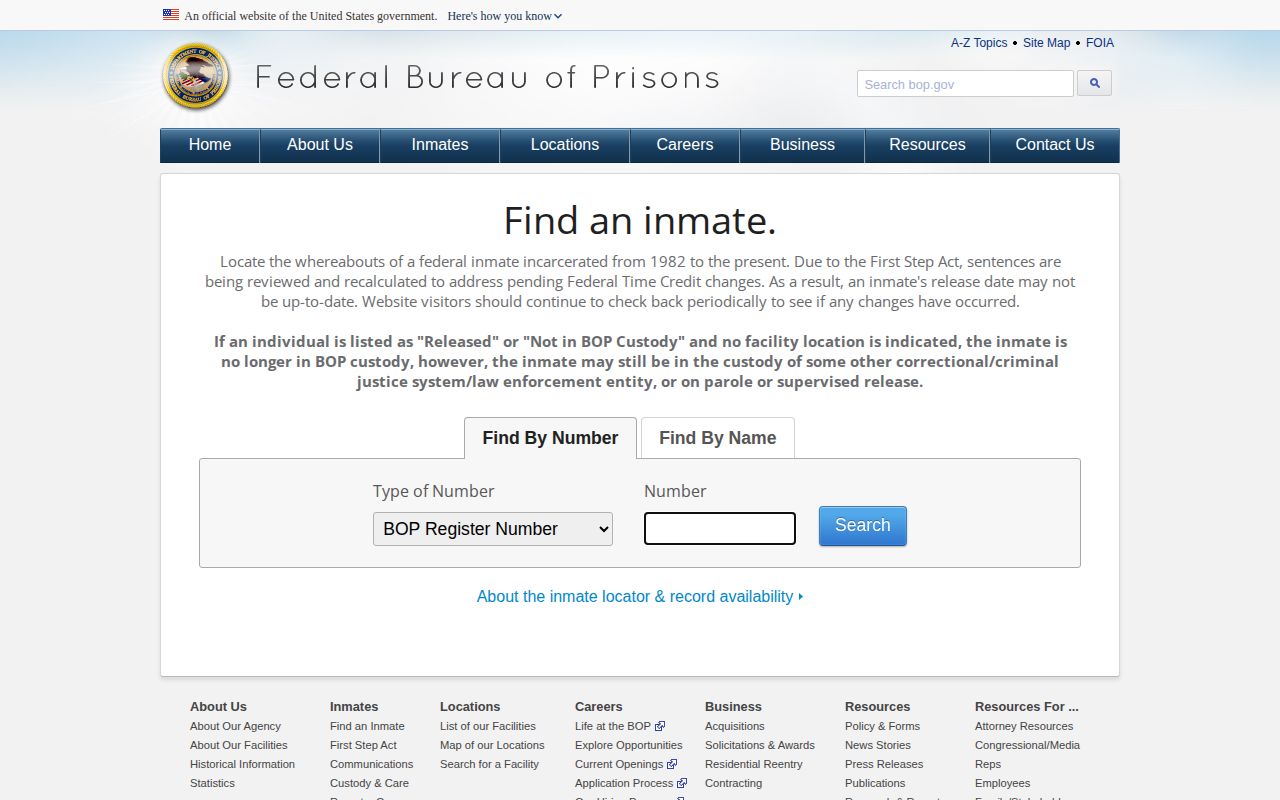
The displayed release date and status belong to federal BOP custody only. A careful record preserves the register number and checks for another agency or court-supervision status.
| Field | How to use it |
|---|---|
| Register number | Use as the primary federal identity match |
| Name and demographics | Compare against the known person and docket |
| Release date | Distinguish past actual-looking dates from future projections |
| Location or status | Read the BOP wording exactly |
USMS Pretrial Federal Custody
USMS manages federal prisoners from arrest or remand through acquittal, release, or commitment to BOP. It can house a prisoner in a local, state, or private contract bed. That arrangement explains why a person in federal custody may not appear in the BOP locator during the early case.
No general USMS public person locator was found. USMS says it does not release public details such as prisoner personal histories, photographs, or arrival and departure times through its general information channel. Its FOIA process can accept a record request, but exemptions apply and production is not guaranteed.
The federal court docket is the main public source for a judicial release from pretrial federal custody. The appropriate USMS district may answer routing questions. If a sentence results and the person is delivered to BOP, the BOP locator becomes the correct later source. Do not use a BOP no-result to declare a USMS prisoner released.
For a Harford arrest that becomes a federal matter, ask HCSO for the receiving agency and transfer date. Then identify the federal case number and district. This creates a documented bridge from county custody to USMS. Without that bridge, a BOP name match may belong to an older or unrelated federal sentence and should not be treated as the next event.
Federal Release Date Changes
A future BOP release date is projected. BOP warns that First Step Act recalculation can affect date currency. Other lawful sentence computations, court action, credits, and custody changes may also alter a future result. Check the official locator again rather than treating a saved future date as final.
A past date paired with BOP’s released wording is stronger evidence that BOP confinement ended on that date. It is still wise to inspect the federal docket for supervised release and other orders. If records suggest an ICE detainer, state warrant, or local hold, continue with that receiving agency.
Federal institutions and release contacts vary by placement. The BOP result’s facility or status information should guide any institution-specific inquiry. Since no BOP institution was identified in Harford County, HCDC should not be called the federal prison and BOP should not be asked for local HCSO booking records.
Federal Bureau of PrisonsNationwide federal institution system
Public custody and release search:
www.bop.gov/inmateloc/