
Harford County VINELink Coverage
Maryland VINE is the custody-notification layer recommended by HCSO on its official HCDC page. Maryland’s service can provide custody status, housing location, release-date information, and notices through available phone, email, text, or app options. Anyone may register. The Maryland VINE telephone line is 1-866-634-8463, and the public web interface is VINELink.
The system extends beyond one jail. Maryland materials describe District Court, Circuit Court, local detention-center, Division of Correction, parole, and probation events. That range can follow parts of a Harford case from court into HCDC, then into state custody or supervision. It also creates boundaries. The record wording and timing depend on the participating agency’s feed, and one registration does not automatically follow every move.
- VINE
- The notification service that distributes custody and case events received from participating agencies.
- VINELink
- The public interface used to search participating jurisdictions and register available alerts.
- Custody event
- An agency-supplied change such as release or another status update.
- Discharge
- The end of a sentence or supervision obligation, which is not always the same as leaving a jail building.
Search One Harford Inmate
Use VINELink for a known person, not as a countywide recent-release feed. Start with the person’s full legal name and any available agency identifier. Name variants may be necessary, but each result must be matched before it is treated as relevant. Agency, available demographics, and identifiers help distinguish namesakes.
- Open VINELink and choose Maryland as the jurisdiction.
- Select the custody-search option shown by the interface.
- Enter the full name or the identification option offered for the participating record.
- Compare the agency, identifiers, and available demographic details across possible matches.
- Open the confirmed record and read the status or event wording exactly as displayed.
- Record the date and time of the search, especially when the result will be verified elsewhere.
Do not rely on a common-name match. A result tied to another Maryland jail or to DPSCS may involve a different case and custodian. If no match appears, retry a documented name variation and then move to the facility, court, and records channels. Maryland materials do not promise that every released HCDC record remains searchable for a set period.
Maryland VINELink Search Screen
The public VINELink interface provides the Maryland selection, a one-person search route, status information, and the notification action for a matched record.
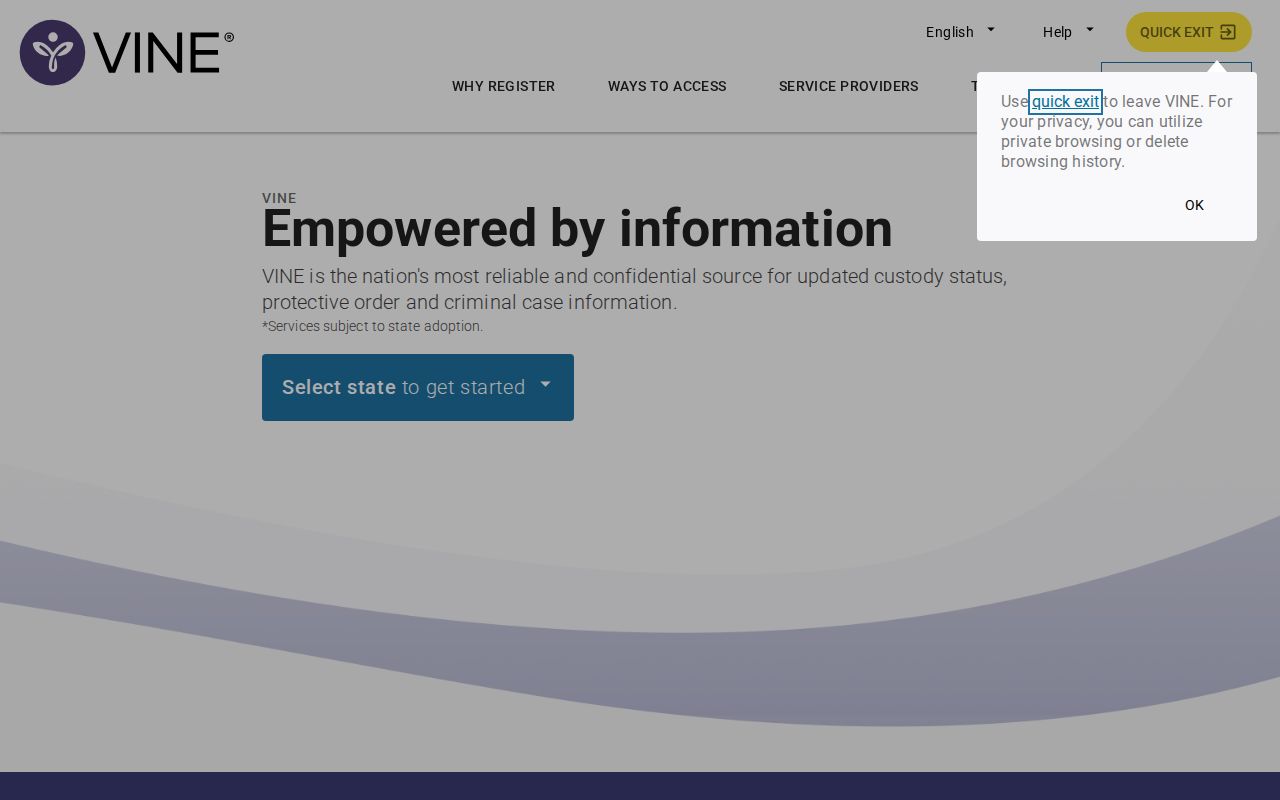
The capture shows why identity matching comes before alert registration. Search controls may change, but the sound sequence stays the same: choose Maryland, identify the correct record, read the exact agency language, then register from that confirmed result.
Harford VINELink Release Result Fields
VINELink presents data supplied by a participating agency, so fields and literal labels can vary. Official Maryland research supports the categories below, but not one universal HCDC released-result layout. Preserve the exact wording and search time instead of translating a status into a stronger claim.
| Result element | How to read it |
|---|---|
| Custody status | The participating agency’s current or event-based status wording. |
| Agency or location | The jail, corrections system, court, or supervision source tied to the record. |
| Name or identifier | The matching information used to separate one person from another. |
| Custody-event information | An event supplied by the agency, which may include a release or other status change. |
| Release-date information | A date presented when supplied and supported by the participating record. |
| Notification control | The route to register available phone, email, text, or app alerts. |
A result that says released or supplies a release event should be quoted accurately. It does not by itself explain the legal basis, exact door time, pending court conditions, or later supervision. A court order may authorize release before jail processing ends. Conversely, departure from HCDC may be a transfer to another custodian rather than return to the community.
Note: Record the agency, status wording, event date, and query time before calling the facility about a mismatch or delayed update.
Register Harford Release Notifications
Register only after confirming the person or case record. Select the notification action and choose among the contact methods the interface offers. Maryland materials describe phone, email, text, app, or available combinations. Multiple phone numbers and email addresses may be registered.
- Open the confirmed person or case record and select notifications.
- Choose an offered phone, email, text, or in-app channel.
- For phone registration, create a private four-digit PIN.
- When an automated custody or release call arrives, enter the PIN followed by the pound sign to acknowledge it.
- For email registration, watch the registered inbox; email notices do not use the phone PIN.
- Search and register again after a known move between courts, local jail, state prison, or supervision.
Do not register a switchboard number. If a phone call is not acknowledged, Maryland’s brochure says repeat calls continue for at least 24 hours. If the PIN is forgotten, call the toll-free Maryland VINE line and use zero for the around-the-clock operator. Keep the PIN private because it is used to confirm receipt.
Harford Custody Moves Need Re-Registration
A Harford case may move between District and Circuit Court, HCDC and a Division of Correction facility, or confinement and parole or probation. Maryland’s detailed VINE brochure tells registrants to re-register after those moves. A prior alert should not be assumed to follow the person across each participating agency.
Maryland sources also carry a transfer nuance. Newer victim-services material says VINE does not notify institution-to-institution transfers, while a detailed brochure discusses transfers among custody changes. The safe response is practical: after any known move, search again, confirm the new agency record, and re-register. Never depend on a silent alert account as proof that no move occurred.
VINE enrollment is separate from DPSCS written victim-notification registration. Completing one does not enroll the other. Choose the channel that fits the event and maintain current contact information in each service used.
Verify Harford Release Across Channels
VINELink is a strong first check, but each source answers a different question. HCDC owns its county custody movement. Maryland courts preserve the judicial events. DPSCS owns state confinement and supervision records. BOP, USMS, and ICE are separate federal systems. A complete channel sweep prevents a county-jail departure from being mistaken for the end of all custody.
| Channel | Best use | Key limit |
|---|---|---|
| VINELink | Participating custody status, events, and alerts | Agency data can lag, and retention is not promised. |
| HCDC | Immediate local status and HCSO custody movement | Exact fields may require a written record request. |
| Maryland Case Search | Bond, release orders, disposition, sentence, and docket context | A court event is not the physical jail-exit timestamp. |
| DPSCS locator | Current covered Maryland state housing | People no longer in custody disappear, so a miss is inconclusive. |
| BOP, USMS, or ICE | Federal sentence, federal pretrial, or immigration custody | VINELink does not replace these agency-specific routes. |
For HCDC, call 410-638-3140 if immediacy matters. For a durable county record, use the HCSO GovQuest portal and request the existing booking, custody-movement, or release transaction. For the court basis, check Maryland Judiciary Case Search in chronological order.
Registry Is Not Harford Release Search
Maryland’s registered sex offender website is a separate, purpose-limited system. It applies only to people who must register under Maryland law. A matching registry record may show authorized identity, status, address, or offense information, but it does not establish the date or type of an HCDC release. A nonmatch says nothing about general custody history.
This distinction matters during a channel sweep. VINELink follows participating custody and case events. The registry reflects a legal registration duty after release for a limited group. HCSO’s CID Megan’s Law Unit is the local designated unit, while HCDC owns county jail movements. Do not use a registry result to fill a gap in the release transaction, and do not infer anything about a person who is absent.
Harford’s unit is listed at 23 North Main Street in Bel Air and can be reached at 410-638-3168 for registry matters. Questions about a jail exit still go to HCDC or HCSO records. Keeping the channels separate prevents a specialized public registry from being misread as a countywide list of released people.
Harford VINELink Search Limits
A no-result is not proof of release. It may reflect a name variation, timing, a participating-agency boundary, a record no longer displayed, or custody in another system. Likewise, a VINE event does not establish that all court matters, warrants, detainers, or supervision obligations ended. Confirm the fact with the office that created it.
Maryland’s DPSCS locator is also not a historical release search. It lists many people in current covered state custody and expressly removes those no longer in custody, including people released or escaped. A successful result points to current state housing. A miss requires VINE, court, supervision, and records follow-up.
Escape is especially important in this warning. DPSCS itself groups escape and release as examples of why someone may be absent from the current locator. Neither should be inferred from a blank screen. The originating agency must identify which event occurred, and the court trail may explain only the legal side of custody rather than the movement itself.
The Harford County released inmates search organizes those county, state, and federal routes for a person whose custody path is not yet clear. In urgent cases, direct confirmation with the facility takes priority over waiting for an alert.
Note: VINE is a useful notification aid, but Maryland materials state that it is not a guarantee and should not replace direct verification.